LogoJET has announced a strategic partnership with MakerFlo, expanding LogoJET’s blank-media ecosystem and its turnkey Print-to-Profit solutions for high-demand drinkware and tumbler applications.
Central to the partnership is MakerFlo’s MakerTwist Tumbler. The purpose-built drinkware line is engineered to increase production efficiency and unlock full-wrap decoration on handled tumblers.
Designed specifically with UV printers and engravers in mind, the MakerTwist Tumbler eliminates common limitations associated with handles by allowing full 360-degree wraps without removing handles, modifying fixtures, or settling for partial prints.
“Customers don’t just want printers. They want a clear path to profitability,” said Michele Choate, vice president of marketing at LogoJET. “Our partnership with MakerFlo, and innovations like the MakerTwist Tumbler, bring together trusted blank media, proven rotary printing capability, and real-world application support, making it easier for customers to produce more, waste less, and scale faster.”
LogoJET notes that its UV rotary technology allows businesses to bring tumbler production in-house, reducing overhead, accelerating turnaround times, and improving margin control.
“The MakerTwist Tumbler was designed to solve real production challenges,” said John Modi, founder of MakerFlo. “By reducing handling time and enabling true full-wrap decoration on handled tumblers, we’re helping customers be more productive with their equipment. Partnering with LogoJET allows us to pair that innovation with a proven UV-printing platform.”
“This partnership removes barriers between setup and success,” said Sumita Patel, customer engagement manager at LogoJET. “By connecting customers to proven blank solutions like MakerTwist and backing them with ongoing support, we’re reinforcing our commitment to delivering complete, scalable production systems.”
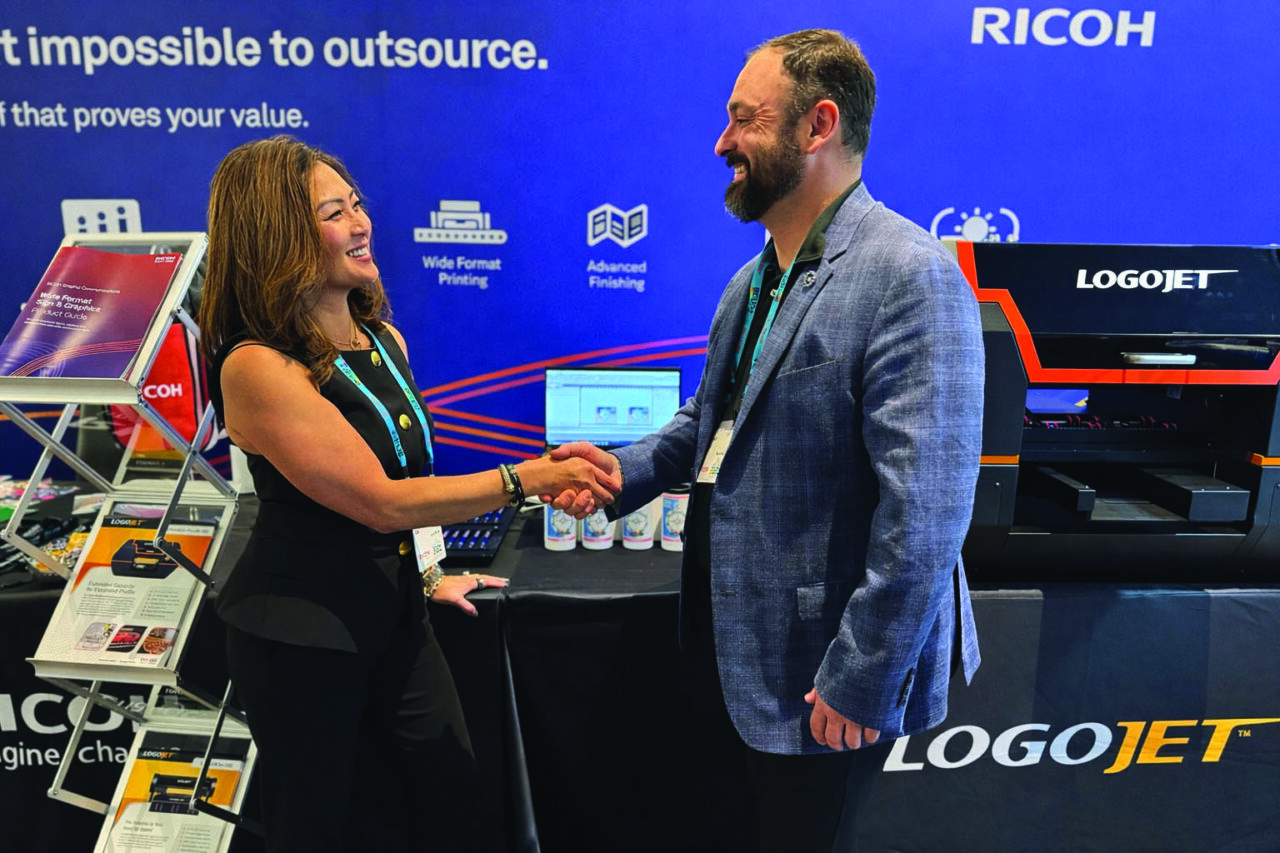
Ricoh USA announced a strategic partnership with LogoJET, expanding its graphic communications portfolio with small-format, direct-to-object (DTO) UV-printing solutions. As part of the partnership, Ricoh said it will offer LogoJET DTO printers in its portfolio of production hardware, software, workflow, and services.
The company attributes the growing demand for more customized, on-demand, and efficient printing solutions across a wide range of industries, noting that the U.S. DTO market is projected to grow at a 9.5% CAGR from 2025-2030.
“DTO represents a natural extension of digital production for customers looking to diversify and grow,” said Andrew Vecci, director, product & portfolio management at Ricoh USA. “By combining LogoJET’s DTO platforms with Ricoh’s expertise in production print integration, customers gain a scalable way to add new applications while fitting DTO seamlessly into their existing production environments.”
As LogoJET’s first distribution partner in North America, Ricoh said the partnership expands access to specialized DTO technology “while supporting customers through consulting, workflow design, software integration, and services aligned with their broader print operations.”
“Direct-to-object printing is one of the fastest ways for print providers to expand into higher-margin applications, from signage to promotional products,” said Susan Cox, CEO and founder of LogoJET. “Through our partnership with Ricoh, we’re extending this capability across their vast network, with aligned support and a shared customer-first culture. We’re excited and proud to take this step beyond our direct sales model, and Ricoh was a very intentional choice.”
LogoJET’s DTO printers are designed specifically for printing on dimensional and specialty items, supporting a wide range of substrates and applications. Through this partnership, Ricoh said its customers can incorporate DTO into “mixed production environments alongside sheetfed, inkjet, wide-format, and finishing solutions.”
By Tim Brown, MAS, Promotional Products Association International (PPAI)
(Originally published in the February 2015 issue of Recognition Review.)
Have you ever questioned whether symbolic awards such as trophies, plaques, and framed commemoratives must meet the requirements of the Consumer Product Safety Improvement Act (CPSIA)? This is a question many suppliers and distributors of symbolic awards are asking these days; for this and many other product categories associated with the CPSIA, there are no clear answers. That being said, understanding the Consumer Product Safety Commission’s interpretation of CPSIA rules can help provide a sound basis for making informed decisions when determining whether CPSIA regulations may or may not apply to a symbolic award based on a given situation.
It first helps to have a basic understanding of the CPSC’s Final Interpretation of a Children’s Product, now codified in 16 CFR 1200 of the CPSIA. This definition of a children’s product states, under section 3(a)(2) of the CPSIA, “a children’s product means a consumer product designed or intended primarily for children 12 years of age or younger. The term ‘designed or intended primarily’ applies to those consumer products mainly for children 12 years old or younger. Whether a product is primarily intended for children 12 years of age or younger is determined by considering the four specified statutory factors. These factors are:
(i) A statement by a manufacturer about the intended use of such product, including a label on such product if such statement is reasonable.
(ii) Whether the product is represented in its packaging, display, promotion, or advertising as appropriate for use by children 12 years of age or younger
(iii) Whether the product is commonly recognized by consumers as being intended for use by a child 12 years of age or younger.
(iv) The Age Determination Guidelines issued by the Commission staff in September 2002 and any successor to such guidelines.
The CPSIA also states, “The determination of whether a product meets the definition of a children’s product depends on factual information that may be unique to each product and, therefore, would need to be made on a case-by-case basis.”
The use of childlife figures and images that appeal to children are likely to classify these awards—from Pacesetter (left) and BCH Unique (right) as children’s products.
The factors noted do not indicate an either/or scenario. For instance “a statement by the manufacturer” that a product is not intended for children is not enough by itself to designate that the product is not intended for children. The remaining factors also must be taken into consideration.
In order to effectively use the criteria in determining whether a product could be deemed a children’s product, we must look not only at the foreseeable use but also at the foreseeable misuse of the product by a child.
PRODUCT INTENT AND USE
Most of us, regardless of age, have received a symbolic award at some point. It may have been for winning a spelling bee, winning a league championship, achieving a professional honor, or participating in an activity. Whatever the reason, a symbolic award elicits a feeling of accomplishment—recognition for a job well done.
There is little difference among recipients, regardless of age, when it comes to what ultimately happens with a symbolic award once ceremonies and celebrations are complete.
Ultimately the symbolic award generally will be placed in a position of distinction within a building or home. Once perched in its place of honor, the award will rarely be removed, interacted with, or otherwise handled by the recipient. Many make this case when attempting to make the argument for not classifying symbolic awards as children’s products, even when distributing them to children.
WHAT THE CPSIA SAYS
The CPSC, through the passage of the CPSIA in 2008, established specific criteria for children’s products, articles, and toys. It is diffi cult for anyone to argue with the intent of the CPSIA regulations. However, due to vague definitions and the vast number of products in our society, there have been many misunderstandings and unintended consequences resulting from the passage of this law. The most notable concerns deal with what actually constitutes a children’s product.
When trying to determine if child-safety laws apply to a recognition product, ask yourself if the award in its most basic state appears to be geared toward children or toward adults. The answer will give you a better idea of how to proceed. The trophy photo is courtesy of Pacesetter Awards.
When referring to a toy, the regulations are easier to understand and apply. Simply walk into the toy department of any retail store and the intended audience is fairly obvious. On the other hand, in the awards and recognition industry, just as in the promotional products industry, the intended audience and/or planned use of a product are not always clear. While this is often where things get complicated, it does not necessarily have to be so. With a basic understanding of product safety regulations, solid processes in place, and the application of common sense, product safety compliance is within reach.
With the definition of a children’s product in place, let’s look at how to apply the four specified statutory factors to typical symbolic awards.
“A statement by a manufacturer about the intended use of such product, including a label on such product if such statement is reasonable.
The purpose is to demonstrate achievement, and the intended audience covers all age groups. Therefore, you must determine:
Who is the intended audience?
Will the award be distributed to children?
Where will the award be distributed?
“Whether the product is represented in its packaging, display, promotion, or advertising as appropriate for use by children 12 years of age or younger.”
Symbolic awards are represented in a way that typically does not promote or advertise “use” by children based on packaging. However, this can be deceiving as many awards feature a childlike or youthful figure.
“Whether the product is commonly recognized by consumers as being intended for use by a child 12 years of age or younger.”
Items such as plaques, medals, ribbons, and trophies, and plastic, metal, or glass figurines are intended for all audiences. The target audience in each situation, along with the design and the appeal to each specific age group, will be determining factors when it comes to symbolic awards. Points to consider:
Does the figure on the award have childlike qualities—does it represent a child or an adult?
Does the award have play value?
Is the award intended for a youth sports team, elementary school, or other youth program?
“The Age Determination Guidelines issued by the Commission staff in September 2002 and any successor to such guidelines.”
Symbolic awards generally have little to no play value. This alone is not enough to make a determination with regard to whether a product is intended for children. The Age Determination Guidelines will provide useful assistance in making appropriate decisions with regard to the application of product safety regulations.
Like promotional products that begin as general use items, these awards are more general in nature which makes it more difficult to make a determination. Many general sports and accolade items would be considered general purpose items unless targeted to children 12 years of age and under. If a plaque was interactive, it would be subject to child-safety guidelines.
APPLYING CPSIA REGULATIONS TO SYMBOLIC AWARDS
When looking at the criteria and applying responsible and appropriate filters, it seems possible to say that many symbolic awards may not meet the CPSIA’s description of a children’s product. However CPSC staff members have said they believe trophies cannot be placed categorically into the general purpose, or nonchildren’s, product category.
Even though many general-use trophies on the market do not have attributes or features that appeal to children or appear youthful in design, a blanket approach to the category cannot be taken. One would need to “examine the physical characteristics of the trophy figure (i.e. what does the figurine’s body actually look like?)” to determine whether or not an award would be classified as a children’s product. If a trophy has a childlike appeal, even if it does not have a child figurine, it is likely to be viewed as a children’s product.
In order to better understand this concept, use the “four specified statutory factors” listed previously, and apply them to the figures provided. Does the award in its most basic state appear to be geared toward children or toward adults? When you have your answer, you will have a better idea of how to proceed.
Like promotional products that begin as general use items, other awards, such as wall plaques, are more general in nature which makes it more difficult to make a determination. Many general sports and accolade items, such as those shown above, would be considered general purpose items unless targeted to children 12 years of age and under. If a plaque was interactive, it would be subject to child-safety guidelines.
Even though symbolic awards are not toys, when children 12 years of age and younger are the target audience, chances are good that the award will be subject to CPSIA regulations.
PROP 65 AND OTHER STATE LAWS
In addition to CPSIA, symbolic awards also may be subject to the laws and regulations of specific states, and these regulations could apply to all audiences, children and adults. California Proposition 65, also known as the Safe Drinking Water and Toxic Enforcement Act of 1986, lists more than 900 chemicals known by the state of California to cause cancer, birth defects or other reproductive harm and to inform citizens about exposures to such chemicals. Labeling is required if unacceptable levels of any of these chemicals are present in a product that will be distributed in California.
In order to distribute products in California, businesses are required to provide what The Office of Environmental Health Hazard Assessment (OEHHA) considers a “clear and reasonable” warning. The purpose is to inform buyers and/or users of products “before knowingly and intentionally exposing anyone to a listed chemical.” These Prop 65 warning labels should be provided by the “manufacturer, producer, or packager of the consumer product, rather than by the retail seller.”
Distribution applies to persons or businesses conducting business in the state of California and can take several forms, most notably selling the product or handing the product out at an event or place of business. Whenever the known distribution point for a consumer product is California, then compliance with Prop 65 regulations in the form of testing or labeling is required. Products purchased or received outside the state of California by an individual and brought into California for a person’s own personal use or consumption currently aren’t subject to these regulations.
When providing “clear and reasonable warning,” a variety of means to communicate such warnings to the extent practicable is set forth in the law. These means include labeling a consumer product with stickers, signs, or labels, posting signs at a retail environment or workplace, or distributing a notice in other ways as defined by the regulation. Warning labels are not required to be permanently affixed to a product, but they are positioned in such a way as to meet the definition of a “clear and reasonable” warning.
By placing a warning label with a product, an organization is communicating that it “is aware or believes that one or more listed chemicals is present. By law, a warning must be given for listed chemicals unless exposure is low enough to pose no significant risk of cancer or is significantly below levels observed to cause birth defects or other reproductive harm.”
The OEHHA has developed “safe harbor numbers” to assist in determining whether warning labels are necessary. As a matter of best practice, testing to determine the presence of any of the listed chemicals is recommended. As a matter of practicality this is often not economical or feasible. Therefore, according to the OEHHA, “a business may choose to provide a warning simply based on its knowledge, or assumption, about the presence of a listed chemical without attempting to evaluate the levels of exposure.”
ILLINOIS LEAD POISONING PREVENTION ACT
Another state requirement that may be applied to symbolic awards is the Illinois Lead Poisoning Prevention Act. This act is, essentially, a labeling law that applies lead limits (40 parts per million) to surface coatings and/or painted decoration used on toys and children’s jewelry. In addition, this act applies lead limits (600 parts per million) to the surface coating or substrate material of adult items. If any of the limits are exceeded, the following warning label is required: “WARNING: CONTAINS LEAD. MAY BE HARMFUL IF EATEN OR CHEWED. MAY GENERATE DUST CONTAINING LEAD.”
Consult your suppliers/manufacturers and testing labs to determine if your product needs labels to meet the requirements of this regulation.
SUMMARY
While product safety on a national level as it relates to symbolic awards has been the primary focus, laws and regulations are especially fluid at the state level, adding to the challenge of regulatory compliance. In addition, myriad factors may affect each given situation to which the points addressed here may not specifically apply. When these situations arise, it is prudent to consult with a qualified testing lab and/or experienced product responsibility attorney
DISCLAIMER This information is provided for educational and informational purposes only. The author makes no warranties or representations about specific dates, coverage, or application. Consult with appropriate legal counsel about the specific application of the law to your business and products.
Tim Brown, MAS, is the product responsibility manager for PPAI, where he is responsible for product safety, environmental, and social responsibility efforts of PPAI, including education and awareness outreach. Prior to joining PPAI, Brown worked at distributor Cintas Promotional Products, as the supplier relationship manager where he implemented industry-leading supplier management best practices. He has served on the Quality Certification Alliance (QCA) Distributor Advocacy Council and on the board of directors for the Tri-State Promotional Products Association (TSPPA) as the 2012 president. He also served as a member of PPAI’s Product Responsibility Action Group (PRAG).
Essential Tips for Calculating Costs, Setting Prices, and Highlighting Your Business Strengths
By: Dennis Wilkinson, Former Owner of D&S Awards
One of the hardest things for a businessperson, whether they are new or seasoned, is determining what to charge for their products and services. Pricing is a critical aspect of running a successful business, and getting it right can mean the difference between thriving or merely surviving.
Unfortunately, too many people try to base their prices on what the competition charges rather than what it costs for them to do business. But how can your competitors’ prices tell you anything about what it takes for you to make money? Everyone’s operations are different, their expenses are different, and their goals are different. So instead of looking at what others are doing, spend some time calculating your costs and getting an idea of how much money you need to be making. Once you have that number, you can price your items accordingly.
Below are some tips for calculating your costs and pricing your items.
Know Your Costs
float right pic of hand on keyboard
Your expenses tell you what you need to charge to make money. Start by calculating your monthly operating costs. List every conceivable, but legitimate, expense. Then break those expenses down into one of two categories—fixed or variable. The fixed costs are the easiest to work with since they don’t change. Things like rent and insurance fall under this heading. Variable expenses, on the other hand, are more difficult to deal with since they are constantly changing. Since these costs don’t stay the same from month to month, you need to estimate what they will be. This is best accomplished by establishing a monthly budget for each item in the variable list. Each month, compare the actual cost to the budgeted cost, and adjust your costing system. Eventually, you will be able to set up your budget with a fair degree of accuracy.
Also make sure to factor in incidentals like equipment repairs and replacements. And consider personal things in your own life like a new car or a vacation. If you’re only planning your pricing so you can get by from month to month, then your whole life will be getting by from month to month.
Following are some fixed and variable expenses you may want to consider when calculating your monthly costs.
Fixed Expenses to Consider
Rent or mortgage
Property insurance
Alarms and security
Auto payment and lease
Auto insurance
Internet
Phone bills
Equipment payments
Variable Expenses to Consider
Utilities
Business license and fees
Repairs and maintenance
Office expenses and supplies
Shop equipment
Furniture and displays
Taxes
Freight and postage
Advertising and marketing
Professional fees such as an accountant, bookkeeper, or lawyer
Website maintenance
Damaged product and mistakes
Owner’s compensation
Savings
Meals and entertainment
Gifts
Travel
Education
Toys and fun
Retirement
Returned checks or bad debt
Dues and subscriptions
Auto repairs and maintenance
Gas
License and DMV
Equipment repairs
Equipment replacement
Computer replacement
Maintenance
Depreciation
Interest expense
Merchant credit card fees
Wages
Employee benefits
Payroll taxes
Workers’ comp
Calculate Your Worth
You also need to factor in how much you want to work. There are roughly 240 workdays per year (if you take out holidays and 10 vacation days) or about 2,000 hours if you work eight-hour days.
Once you figure out how much you want to work, and you’ve calculated all your monthly expenses, it’s time to do a little more math. Take your monthly profit total, subtract your total monthly expenses, and divide that by the number of days in the month you want to work. How does that number look? Is it what you want to be making? If not, it may be time to increase your prices.
Focus on Service and Quality
Customers who do business with you because of the quality of service first and pricing second are the ones who will stay with you. And those are the customers you ultimately want. Price shoppers who are always trying to get a better deal don’t typically care about quality or service. Lawrence L. Steinmetz, Ph.D., lays out the problems with price shoppers in his book How to Sell at Prices Higher Than Your Competitors. He says that price shoppers forget to pay, tell everyone how little they paid, drive off good customers, won’t buy next time unless the price is too low again, lie to you, and steal from you. If you’re trying to have the lowest prices in town, you’re likely going to attract customers like this. You owe it to yourself to price things high enough to build a profitable business. Don’t try to be a low-price leader.
Here’s another way to consider it: Think back to the last time you went out to a nice restaurant for dinner. Can you remember what you paid for the meal? Can you remember the experience? Was the food good? Was the service to your liking? I’m guessing you can’t remember what you paid, but you probably have a detailed recollection of the experience. All of this is to say that if you compromise price, thus reducing service and quality, you have done your business a great disservice. Months later, the customers will forget the low price and will only complain about the service or quality.
Stick to Your Prices
Establishing a strategy and policy around pricing can be difficult, especially when times are slow or a customer says they can get it cheaper elsewhere. But remember that you are in business to make a profit. If you cut your price to match your competitors’, that comes right out of your pocket. When customers tell me they can get an item or service cheaper somewhere else, I just say, “OK. Have a nice day. Thanks for coming in.” A lot of times, they’re bluffing, or they don’t want to go to another place, so they end up going with my price.
I also don’t recommend offering discounts often. The word gets around when you do that, and then it can get harder to sell things at the full price. And it can be difficult to quote prices on the spot. Make sure all items and services have clear pricing. This will help you stick to that pricing.
Highlight Your Strengths
Just because you’re not the cheapest doesn’t mean you can’t be competitive. Find what makes your business special and capitalize on that. Maybe you can offer quicker turnarounds than your competitors or better quality. Maybe you specialize in something that no one else in your area does.
Ultimately, by leaning into your unique strengths, you can justify your pricing and attract a customer base that values what you offer. Instead of competing on price alone, compete on the unique value you bring to the table. This approach not only helps in maintaining healthy profit margins but also builds a loyal customer base that appreciates and supports your business for its distinctive qualities.
It’s unwise to pay too much, but it’s unwise to pay too little, too. When you pay too much, you lose a little money … that is all. When you pay too little, you sometimes lose everything because the thing bought was incapable of doing the thing it was bought to do. The common law of business balance prohibits paying a little and getting a lot. It can’t be done. If you deal with the lowest bidder, it is well to add something for the risk you run, and if you do that, you will have enough to pay for something better. — John Ruskin
Dennis Wilkinson has more than 33 years of experience in the awards and personalization industry. He founded D&S Awards in Santa Rosa, California, in 1991, selling it earlier this year. He has played an integral role in APA for more than three decades. Today, he continues to work at the business he founded.
Find Out Why Some Businesses Choose to Lease Big-Ticket Equipment Purchases
By Carey Kroll, Geneva Capital LLC
Do you have your eye on a new piece of equipment for your shop—or have dreams of starting your own business—but have no idea how you’ll pay for it? Lease financing may be your answer.
Equipment leasing is simply an alternative financing option. Most lease companies offer both a true tax lease and a capital lease option, which is similar to more traditional loans. The best choice often comes down to how you’d like to write off the purchase for income tax purposes.
Equipment lease financing is chosen by small mom-and-pop shops and big business alike. Lasers, printers, and sandblasting equipment are an excellent fit for lease financing. Business owners are not limited to certain brands, though those with subpar credit may be able to get better terms when choosing equipment manufacturers that work closing with the leasing company.
What Are the Typical Lease Terms?
Lease terms range from 12 months to 60 months with the most typical terms being 36–60 months (3–5 years). The term and required down payment are based on the time the business has been in operation, the business’s credit, and the owner’s credit.
Can I Lease to Own?
Absolutely. About 95% of Geneva Capital’s clients select a “lease-to-own” plan or true tax lease. This option has a lower monthly payment with a balloon payment at the end. This is especially appealing to new companies and those that need some time to turn the equipment into a profit center. Companies also like the option to trade the equipment in at the end of the lease period since they may not know where their business will take them in the next few years or what changes technology will bring. You may be able to write off the monthly payments each year to maximize tax savings.
The alternative is a capital lease, which may be preferred by business owners who like the idea of owning the equipment rather than leasing to own or who are more familiar and comfortable with that option. Some business owners may choose the capital lease so they can take advantage of the Section Code 179 deduction, which may allow them to write off all of the cost in the first year. This deduction requires the income to offset the write-off, so it’s not an option for a lot of companies.
Why Does Leasing Offer a Tax Advantage?
In general, the Internal Revenue Service (IRS) does not consider an operating lease to be a purchase; instead, it is a tax-deductible overhead expense. Therefore, with a true tax lease, you can deduct the lease payments from your business income, resulting in a greater write-off than depreciating the purchase (as is required with a cash or loan purchase). With a capital lease, you may be able to use IRS Section Code 179 to write off the entire purchase the same year that you acquire the equipment. This is one of the biggest advantages to leasing. Consult your tax adviser for your specific situation.
Does Leasing Require a Significant Down Payment?
Not usually. Most commonly, the first and last month’s payments are collected upfront.
How Does Leasing Affect My Cash Flow?
Leasing has a positive impact on cash flow because you’re not paying for the equipment in one lump sum. By selecting a lease, business owners can conserve cash for other uses such as advertising, inventory, payroll, and other expenses. Leasing also allows for you to budget more accurately as you know the amount and number of lease payments and can be structured to reduce your payments for a specified duration each year to account for the seasonality of your business.
Business Is Good; Can I Lease More Equipment While Still Leasing My Existing Equipment?
Yes. Leasing companies can approve an application in a matter of a few hours and often with less documentation the second time around. This allows for you and your company to react quickly to new opportunities.
Can Leasing Help Protect Me from Equipment Obsolescence?
Yes, depending on the structure, a lease can allow equipment to be returned to the lessor at the end of the lease term. This allows you to upgrade your equipment and keep a competitive advantage by avoiding having obsolete or worn out equipment.
How Does Leasing Look to Potential Lenders?
Operating leases are not considered long-term debt or liability on your balance sheet, which makes you look more stable to lenders when you need them.
Is Leasing Flexible?
Absolutely. Lessors offer flexible terms that enable you to customize your lease to a program that will fit your needs and requirements—cash flow, budget, transaction structure, cyclical fluctuations, etc. Some of the most popular customizable programs are no money down, no payments for three months, or reduced payments during your historically slow season.
There are many options when determining financing for your equipment. While leasing works well for many, it’s not the solution for everyone. Consulting a tax professional or a financial advisor may help you decide the best choice for your unique situation.
Carey Kroll is regional sales manager at Geneva Capital LLC, a member of the Awards and Personalization Association. To find out if leasing is the best choice for you, or to create a leasing plan of your own, contact Kroll by calling 800.408.9352 or visiting www.gogc.com. Attending the Great Lakes Awards & Personalization Expo October 23–24 in Toledo, OH? You can talk to Kroll in person about the specifics of your business and the possibility of leasing equipment.
Try New Strategies To Avoid Losing Business To Tough Customers
Fran Carville, CRM CARCO AWARDS/CARCOAWARDS.COM
Over the years, we have all made decisions about our businesses that have allowed us to be more competitive. We have taken our brick and mortar stores online, allowing us to win customers on a much larger stage. We have gone from traditional marketing strategies like direct mail to social media marketing. We have transitioned from trophy dealers to personalization retailers.
We have expanded our product selections to include crystal, gifts, promotional products, and silk-screened items. We have kept ahead of the curve by attending trade shows, participating in seminars and webinars, and creating a presence not only in our local communities, but with online consumer communities. Yes, we have worked very hard to stay competitive in the marketplace.
It’s a good thing we have worked so hard! Even as the number of awards retailers has decreased in the past 15 years, the number of unconventional competitors continues to increase. We have always competed successfully against local jewelry stores and gift shops. But now, in addition to competing with every awards retailer online, we find competition in unexpected places. Now big box companies like Walmart sell trophies on their website. Consumers involved in sports can purchase awards from the sport’s governing association’s online store. Many professional organizations offer awards to their local chapters. We compete against sorority and fraternity member stores and the online shops of religious and civic associations. That’s a lot of competition. So how do you win new customers?
WIN WITH THE DIY CROWD
As I recall, the DIY consumers really became a force during the recession several years ago. “Spend less, do it yourself, cut out the retailer.”
For our store, it started with customers making their own custom certificates. Years ago, many awards retailers did a lot of custom certificates. A lot! But with color printers in every office and school, customers realized they could produce their own certificates in-house. These certificates did not look as professional as the ones we produced, but many felt they were good enough and saved money. For us, it meant lost revenue and a lost category of merchandise sales. What could we do? We have been able to recoup a percentage of this business as consumers realized just how much time and effort they waste producing these awards in-house—but much of the custom certificate business is gone forever. How do you win these DIY customers?
We took our list of custom certificate customers and did a marketing campaign aimed at making their DIY certificates more professional by using our certificate plaques and frames to display and present their certificates. And guess what? Many of these former certificate customers now bring their DIY certificates to us, and we sell them the frames and plaques to complete the award. We actually have increased sales by losing the custom certificate business to the DIY crowd.
What category of business have you seen decline in recent years? How can you connect in a different way with DIY consumers? Many times, rather than lose a group of customers, we can find ways to convert them to customers that now purchase from your business in a different way. However …
A couple of years ago, a loyal customer of ours got a new representative. This group typically ordered 150 trophies a year. But the new representative decided she could save the group money by purchasing our least expensive medals and making the neck ribbons herself. It caused a drop in sales for us, but we kept the business and a chance to eventually return to the more expensive trophies. And then, last year the representative teamed up with a “DIYer” and we completely lost the customer. They decided to make 150 “medals” out of paper plates. That’s right. Eight-inch paper plates, spray-painted gold on a handmade ribbon drape. They even “engraved” the back with an ink pen. How does one compete against a paper plate!? I have not figured that one out yet. Our company will continue to market quality awards and new, innovative products to this group. Paper plates?????
WIN WITH THE THRIFTY CROWD
There are consumers in every marketplace who truly believe they deserve a deal. Not their job to ensure your success. Not their job to care if you can afford employee raises. Not their job to expand your business. No, their only job when doing business with your company is to get a good deal. Many retailers will write off the thrifty crowd without even trying to make a sale. And while I agree that this group of consumers may never be your most loyal, it might be in your best interest to find ways to successfully sell to these shoppers.
Many retailers believe that the only way to make a sale with someone looking for a deal is to offer them a discount. Not so! Several years ago, a long-time customer spent time telling us that she needed to get a better price for her awards, because she had just hosted a very expensive party. Grrr. It might have been easy just to have given her a discount on the same awards, but that is not our store policy. Instead, we showed her awards that were available in her new budget. She was a happy camper; she spent less and still got nice—though smaller—awards. We were happy because we kept our profit margins and satisfied the customer.
The point is a thrifty customer will normally be excited to see a display of awards with signage stating “budget busters” or “affordable elegance.” There is no reason that your lowestpriced awards can’t look great and be appealing to the budgetminded customers. Over the years, some product lines have become too expensive for the thrifty crowd. This happened in our store with inexpensive wine glasses. The unit cost of the glass combined with the freight costs put this once inexpensive product out of reach for many customers.
Did we lose this business? Yes and no. Now we refer customers looking for the least expensive glass to one of the dollar store chains, where the same wine glass sells for less than a dollar. The customer purchases the glasses and brings them to us for personalization. These customers don’t seem to mind paying for our regularly priced services. We carry no inventory, and we make a much higher profit on personalization. The thrifty customer is delighted that we helped them get a deal on the glasses and love that our store makes their under-a-dollar items look special. Win-win!
How can you help your customers save money without sacrificing profits? Thrifty customers can be a good source of additional revenue if you take the time to develop a game plan for working effectively with this group.
WIN WITH THE LAST-MINUTE CROWD
Every year, it seems that more and more customers give us less and less lead time to produce quality awards. Our choices are to keep our turnaround time on track and walk these customers or find ways to meet the customers’ deadlines. Sometimes a request will be impossible to achieve, but we must always remember that when we say no, the customer may never be back to give you another chance. There will be a competitor out there that will do whatever is necessary to satisfy the customer. Saying no probably means waving goodbye to the customer’s money forever. Instead of walking business, let’s find ways to accommodate these last-minute customers while maintaining our production schedules.
Many suppliers offer specific products for quick turnaround. As retailers, we can do the same thing. Identify awards that you can produce quickly and always keep in stock. Label these products in your showroom so the lastminute crowd can see their options. A trophy customer might have resins and medals to choose from rather than traditional component trophies that are more labor intensive. Try to offer a nice variety in each category of awards so that these customers have good options and don’t feel that you are trying to get rid of slow-moving inventory.
The number of last-minute customers has really increased during busy season at our store. This has created real problems—and opportunities—for our business. Without enough hours to complete the end-of-school orders placed in advance, how do you take care of the last-minute crowd? For the past 3 years, we have set up an area in our showroom marked “Cash & Carry.” Customers that need to take awards with them have a nice selection of prebuilt trophies; medals with red, white, and blue neck drapes; stock ribbons; and chenille pins. Our signage states that no engraving or customization is available on cash & carry items. We sell our regular merchandise at full price, and the customers are absolutely thrilled to be able to have awards immediately. Many come back early the following year and place their full orders.
Times have changed, and many customers will no longer tolerate lengthy waits. If you think about it, we are one of a few industries that doesn’t make it possible for a customer to just pick merchandise off of the shelf and take it with them. Consider a cash & carry display for holiday gifts to increase your sales and satisfy the last-minute crowd.
WIN THE VIRTUAL CROWD
No one in the awards industry would discount the importance of a presence on the Internet. The fact is that more than 60% of today’s consumers would not consider becoming a new customer of a company with no online presence. Yet I am always amazed when a potential customer is excited when I tell them that we have a virtual store.
Most consumers that shop online would prefer to shop with a local company, but somehow the dots are not always connected. It is our job to let consumers know that they can shop in our virtual store the same way they would shop in any online store. As important as your online store is, having an online presence aside from your website is also important to win over the virtual crowd. Using social media to build your business includes having current customers post photos of their awards ceremonies and asking nonprofits to promote their fundraisers with you. Giving online consumers reasons to return to your sites over and over is a great way to market your business and grow your customer base with the virtual crowd.
HOW DO YOU WIN CUSTOMERS?
Competing with other businesses is hard, but competing against yourself may be the hardest thing you will ever do. Are you better today than you were yesterday? Do you have an achievable plan to be better tomorrow? Competing to win customers keeps us on our toes, always looking for ways to better serve our customers. And that’s a good thing, because we will never be bored or complacent. We will spend every day working to win customers.
Fran Carville, CRM, is an Awards and Personalization Association past president, educational speaker, 2008 Speaker of the Year, a member of the Hall of Fame, and winner of an Award of Excellence from the APEX Awards for Publication Excellence. Fran and her husband, Tom Carville, CRM, own Carco Awards in Baton Rouge, LA.
It’s Time to Get Motivated to Make Change Happen in Your Business
By Pamela Deats, Custom Built Awards
So you read my article in last month’s issue of Insights, you’ve identified your perfect niche, and you’re excited to make some positive changes to your business and your life.
You’re officially ready to go!
But chances are you’re asking yourself an important question right now: Where do I even begin?
The good news is that finding your niche and wanting to make a change is half the battle. The not-so-good news is that now you’ve got to do the part that often seems the scariest: making it happen. But I’m here to tell you that with a few changes—and a bit of courage, motivation, and dedication—you can add more of what you love to your product lineup and make every day at work a little better for both you and your staff.
Find Your Equipment
Someone once told me that equipment is like underwear: nobody sees it, but you gotta’ have it. And that is never truer than when you’re trying to target your operations in a whole new way. Before you start buying up substrates and telling your customers about the exciting new offerings coming to your shop, you have to have the means to make it happen.
Analyze what other retailers are doing to the products you’d like to sell or concentrate more on; a good place to start is the Awards and Personalization Association’s Member2Member Forum, where retailers are sharing their work and questions every day.
Are people adding vibrant color to that product? Are they using acrylic? Is there a part of the product that you love, but can’t quite figure out how they made? And, most importantly, are these all things you can do in-house?
If the answer to that last question is no, then it’s time to start shopping. For many of us, the prospect of spending money—especially on a large, expensive piece of equipment—is a frightening one.
But when it comes to making that purchase for the good of your business, you can’t operate on “scared money.” You can’t be afraid to step out and purchase a piece of equipment or a full case of product when you need it. After all, these are the building blocks of your business.
If you are scared, your money is scared, and you will fail. Don’t set yourself up for failure from the get-go: Just shut your eyes and go for it!
If you know you need to do something to appeal to that niche, but you’re not quite sure what to do, invest in finding out. You can attend educational seminars about certain processes, visit local suppliers for hands-on demonstrations, and reach out to your fellow association members to learn more about your investment and how to make the best decision.
But the investment isn’t just financial; it also needs to be an investment of time. Take an afternoon off from selling to learn a new skill or research a new process. Sure, you might miss a phone call or fax about an order, but you can’t be afraid to invest just as much in your future earnings as you do in your current ones.
Find Your Customers
If having the tools to get the project done is the most important thing, then the second most important thing is ensuring that—after all that time and effort—there are customers who will buy what you’re trying to sell.
If your niche is an entirely new area to you, talk to your fellow association members who already work in this area about what you may be able to expect. You also can talk with members of your community to see what opportunities may already exist.
For example, if you’re looking to dive into sports products, talk to local schools and other groups that offer those activities to better understand future trends, current needs, and what expectations they have of their suppliers. If you want to work with local nonprofits, set a time to visit their office or a community meeting to learn more about what they do.
If you’re looking to expand on a product line you already offer, you can take advantage of the customer base you already have to see what the market looks like for future sales. Ask them what additional products they’d like to see, what special decorations they may prefer, and whether they have anyone in their network who might also be looking for those products.
And remember, people love to talk about the great deals they’ve found or the wonderful vendors they’ve worked with—and your customers are no different. Don’t hesitate to ask your customers for referrals, especially in the beginning when you’re still building up that new portion of your business.
Then, once you have a handle on who you’ll sell to, set up your shop to ensure that if any of these new potential customers come in, they immediately know that they’re in the right place. Position items related to your niche front and center, and ensure that when customers come in, you mention that display.
Find Your Motivation
Finding the right equipment and customers will get you pretty far, but the most important part of making any change is maintaining the motivation to make it happen. With our busy lives and even busier work schedules, it can be easy to keep kicking the can of change down the road as we wait for the exact right moment to move forward.
Think about what you do every day: You listen to what a client tells you, and you translate that into art. You look at a blank plaque and you can visualize every detail that will make it great.
Whether it’s engraving a trophy or creating something entirely new that you’ve never even seen before, you know what the right thing to do is. Because you have this industry in your blood.
You already know in your heart what the right decision is for your business; and just like with any other project or order, you need to make that decision happen!
When I first started in the awards and personalization industry, I only had about 144 sq ft to work with, but I knew that what I wanted most was to move my business into a big building that I could call my own.
So, with every order and every day, I concentrated on that goal. And, after many years, I accomplished it: I now have 26 employees and a beautiful building that we’ll be adding more space to shortly!
I didn’t reach that goal right away. In fact, it took me about 31 years to do it. But I knew where I was going.
Every move into a new building, every new employee hired, and every new product added to my lineup was a step forward.
And I treated every one of those steps forward as what they were: progress worth celebrating. After all, that’s what we do in this industry, isn’t it? We help others celebrate their accomplishments in a way no one else can.
A trophy may just be an object, but if you’ve ever seen an Olympian staring adoringly at their prize, you know that those medals are a lot more than just ribbon and gold; they’re the acknowledgment of ultimate success. How many times have you seen someone holding a plaque or trophy proudly? How many times have you done it yourself?
That’s what drives my love for this industry, and what drives all of us to dedicate so much of ourselves to our businesses—we have this in our blood.
So if you feel that motivation flagging or that fear of change creeping in, just remember: every step forward is a step closer, and that deserves acknowledgment. And the only way to reach a goal is to keep moving toward it, step by step.
Pamela Deats has shared her insights as a speaker at the International Awards & Personalization Expo. Custom Built Awards specializes in trophies, plaques, name badges, ribbons, medallions, and gifts for businesses, schools, organizations, sports leagues/teams, and churches. Based in Humble, TX, the shop custom builds every award to the customer’s order.
I have one question for you: Are you everybody’s everything, always?
Do you go beyond product diversification to offer everything anybody could ever need in your shop—even things you don’t like that don’t sell? Do you let your customers dictate what they need and how they’re going to get it—even when it’ll cost you too much time, money, or stress?
Think about it. When a customer needs to approve artwork but doesn’t do it until 5 pm the day before your order is due, what do you do?
Chances are good that you just say yes. And although saying yes is a good thing, I’m here to tell you that sometimes it’s the things that you decide to say no to that make you and your business better.
You may be asking, “How could saying no actually improve my shop?” Determining which products to forgo so you can concentrate on the ones that sell can help you focus your efforts; target your customer base; create even better products; and, ultimately, develop a prosperous, positive working environment that you can’t wait to get to every day. That’s what happens when you find your niche.
Sizing Up Your Sales
But where do you begin? Whether you’ve been in business for 1 year or 100 years, the first step is to explore your work style, personal preferences, current customer base, and capabilities.
I like to do this using a simple exercise, which I’ll demonstrate here. When I speak on this subject, I like to give my audience some premade worksheets that they can fill out and encourage them to save their answers in their purse or pocket for later. I recommend that you write down your own answers. Trust me, you’ll want to look at this sheet again.
First, let’s explore your customer base.
Ask yourself:
Who is your largest customer or largest customer base?
Who is a middle of the road customer or customer base for you? What customers make up a middling portion of your business?
Who or what is your smallest customer or customer base?
To know what customers you want, it’s important to explore what customers you already have. Do you primarily cater to local sports teams or schools? Are corporate clients the bulk of your business? Is there an audience that makes up a very small portion of your business, but who makes your heart happy with every order? Or one you’re catering to constantly, but that leaves you feeling drained?
And, most importantly, are all of these the customers you actually want?
I once had a wonderful conversation with a woman who told me that by cutting her client base, she actually improved her business. This woman and her husband were making millions of dollars a year in revenue—but they were miserable. They were working too hard, for too long, and it was affecting their lives well outside of work.
So what did they do? They went through their Rolodex and identified the customers they simply did not want to work with anymore. Slowly but surely, they cut names from their contact list until about two-thirds of their business was in the trash pile.
Does that sound crazy to you? It did to me, too, until she told me the rest: Now, many years later—after targeting their operations to the products and customers they loved—they’re back up to earning similarly high revenues, but now they wake up every morning excited about their work. Now, this doesn’t mean you should eliminate the bulk of your business—but it does show that doing some strategic cutting can have serious benefits.
Labor of Love
Now that you have a handle on your customer base, let’s explore what you do for them. Everyone has certain tasks that they love and a few that they loathe.
Sure, there are some tasks that you’ll always have to do. I don’t know many people who love cleaning their shop, but it’s a necessary evil in our business. But there are some things you don’t have to do.
Ask yourself:
What product do you enjoy making the most? What product gets you up in the morning to go to work?
What product is something you just do? What product do you not really mind working on, but you could really take it or leave it?
What product do you absolutely hate? What products do you dread having to work on?
I will tell you, one thing I dislike doing is perpetual plaques. And everyone in my shop knows, when it comes to handling those teeny tiny screws we so often have to work with, they’re better off asking somebody else. I don’t like doing that task, so I let go and ask others do it for me.
So what tasks do you find yourself dreading—and how much of your working time is spent on those tasks?
Let’s look at your answers to see how each of your boxes are matching up: Is your largest customer your box four, the product you most love? Your box five? Or, even worse, your box six? Do you have an established customer base, whether it’s your largest or your smallest, that needs products you absolutely love to make?
Although this exercise may seem simple, I’m willing to bet that before now, many of you hadn’t evaluated your client base from the perspective of building more of business around what you’d like to do.
But now that you have an idea of what products you love and what you’ll need to do with your current client base to ensure you can sell those products to them, you’re one step closer to finding a niche. The next step? Learning a few more tricks to help you say no more strategically and get more satisfaction out of every time you do say yes.
Pamela Deats has shared her insights as a speaker at the International Awards & Personalization Expo. Custom Built Awards specializes in trophies, plaques, name badges, ribbons & medallions, and gifts for businesses, schools, organizations, sports leagues/teams, and churches. Based in Humble, TX, the shop custom builds every award to the customer’s order.
Could Facebook and Instagram be the Free Gift That Your Marketing Plan has Been Waiting For?
Social media offers industry retailers a cost-effective way to win over new customers, build loyalty from clients, and market product diversity. Photos and videos that are posted online are ideal for showcasing gifts, apparel, and signage to spread the word that your business offers so much more than your target audience realizes.
Managing social media does not have to be a chore, as evidenced by Tacoma Trophy and K2 Awards & Apparel. These Awards and Personalization Association member companies are very different retail operations with diverse approaches to creating and posting content and measuring the return on their investment.
Even as they seek to reach dissimilar audiences, both agree that social media is an important part of their marketing efforts.
RISKS AND REWARDS For today’s small business, social media is a double-edged sword. It is an affordable way to reach a wide audience and build brand recognition—for a company that has crafted the right online marketing strategy.
Effective social media use also gives personalization companies real-time insight into what other media-savvy industry businesses are up to. This enables suppliers to see how retailers use their products and those of their competitors, and retailers can scout out potential suppliers to learn much more than they could from an online product catalog.
On the flip side, social media can damage profitability when negative reviews are prominent or you make a social media misstep, such as sharing a joke you didn’t realize is offensive or misusing a hashtag regarding a sensitive topic.
A buttoned-up, all-business approach to social media reduces risk but doesn’t enable you to capitalize on social media’s ability to humanize businesses. Getting a little personal on social media can make customers view your brand with the fondness they usually reserve for people.
With the right social media usage, a corporation—not an individual employee or ad—can be viewed as funny, clever, hip, flexible, knowledgeable, or caring, all before a customer has had any contact with an employee.
Social media as we know it today started in the late 1990s, but it didn’t explode until Facebook. Just like Google relegated Altavista and Dogpile to the search-engine graveyard, Facebook made us forget all about MySpace.
Facebook now reports more than 2 billion active users worldwide, the most of any social media platform. As of September 2016, more than 60 million businesses had Facebook pages.
Count many Awards and Personalization Association members among them. Our 2016 member survey revealed the nearly half of our members consider social media one of the top three ways they promote their businesses.
Facebook was the most popular platform, with 67% of respondents using it to promote their businesses. LinkedIn and Google Plus were distant second- and third-place finishers, respectively, followed even more distantly by Twitter, Instagram, Pinterest, and Snapchat.
About a third of our member business respondents don’t use social media, compared to about 24% of American small businesses that have no social media presence. Not being on social media at all is a gamble, especially as more shoppers research companies online before visiting the brick-and-mortar location to make a purchase.
With millions of businesses vying for social media users’ attention, how do personalization retailers use it to sell?
Judi Brown, Tacoma Trophy, Lakewood, WA
“We owe some of our success to the fact that we’re quite active on social media, where many of our local competitors are not,” said Judi Brown, who operates Tacoma Trophy with her husband, DJ.
“The ease in posting and sharing and liking—and the fact that it costs nothing but a little time—is a no-brainer as far as I’m concerned,” she said.
The small business uses the World Wide Web to seek customers from its own corner of the world. “Our goal with all of our marketing is to get people into our store,” she said.
To that end, she posts social media updates several times a week. Owning that process lets her control and organize the store’s marketing efforts, both on- and offline.
Retailers can split the task of social media posting between employees, she said, “but you want to make sure there is some coordination about what’s being posted and when.”
One way for employees to get in on the action is to share Tacoma Trophy’s content on their personal accounts.
“We encourage our team to share Tacoma Trophy posts on social media. Some do, some don’t,” she said.
Sharing the content with their friends and followers could lead to a bonus if one of these contacts makes a purchase. “We offer our team members commissions on sales to new customers they introduce to our store,” Brown said.
PICKING PLATFORMS Brown began using LinkedIn regularly in 2007 and started her personal Facebook account in 2009.
“Around 2010-2011, I started seeing the value of Facebook for our business,” she said.
Since then, a lot has changed, but Facebook is still a staple.
“I use Facebook regularly,” Brown said. “I created an Instagram account recently, but haven’t utilized it much. I’ve had a Google Plus account for several years; I don’t use it too often, but I do believe posting there helps with Internet exposure. I also have a Tacoma Trophy Twitter account that I use a few times a month and a Tacoma Trophy LinkedIn page that I post to a few times a month. We also have a presence on Yelp and have had some positive reviews from customers there.”
CONTENT STRATEGIES “Truly, we have followers that range in age from early teens to senior citizens and from all walks of life so I don’t target messages to any specific demographic,” Brown said. “I try to be mindful to post items that will not be offensive to anyone. I stay away from religion and politics.”
Anything that might promote the store is fair game. “I also ‘like’ a lot of posts as my business as opposed to just liking as me personally,” Brown said. “I feel the name recognition sticks the more people see it.”
Content she creates to promote Tacoma Trophy on social media—sometimes cross posting—includes:
Products: “With the customers’ permission, I often share photos of completed customer orders, and I like showing photos of new products we have on display in our store,” Brown said. “We use Facebook specifically as an extension of our website. When customers call our store and ask if we offer a certain item we’re often asked if they can see everything on the website. We tell them to check out our Facebook page instead because it’s updated much more frequently.”
Staff: “I share photos of our team at work as I want our customers to be familiar with the faces they will see at our store.” During busy season, Brown posted a photo of a staffer who’d fallen asleep while sitting upright in a chair, with the caption: “The picture says it all—one of our team members during the last week of what was our busiest month ever.”
Events: “When customers post photos of awards being presented and I know they are awards we produced, I like and often share their posts,” Brown said. “If we participate in events, I share photos of our displays or of action from the events. We have sponsored various teams, car shows, golf tournaments, and community events and we always try to cross-promote those teams and/or events on our page.
Customer feedback: “If customers e-mail us with good feedback on an order I will sometimes use the customers’ quotes in my Facebook or LinkedIn posts,” Brown said.
MEASURING ROI Part of the lure of social media for businesses is that the medium is, for the most part, free to use. You also can pay to advertise on social media platforms, targeting the types of users you want to see your ad.
Tacoma Trophy tried a “small budget campaign earlier this year. We generated one or two more ‘likes’ but not enough to make me want to invest any more into it,” Brown said.
For now, her investment remains the time she spends planning, generating, and posting content and interacting with other users. Brown’s time is valuable, but it can be difficult to find an accurate way to assess the return on the time you invested in a specific marketing effort.
“We ask all first-time customers to our store how they learned about us,” Brown said. “Most often, customers will say, ‘online,’ in response to that question. We don’t track social media specifically.”
However, Tacoma Trophy has earned new clients and product inquiries through social media. “This most often occurs when a current customer shares something about a product they purchased from us, and people who follow them start inquiring about it,” Brown said. “We also get random inquiries from people who find us through various online searches.”
A post of Father’s Day gift ideas on Tacoma Trophy’s Facebook page has an exchange below it in which a Facebook user asks Brown for the price of one of the featured items. Had she not posted it, what are the chances that the same customer would have happened to come into the shop and that the Browns would have happened to have that specific product front and center, prompting the same inquiry?
Unlike a phone call, when an inquiry comes in through Tacoma Trophy’s social media accounts, Brown can effortlessly refer back to the details later for follow-up: “When customers message us through our Facebook page or LinkedIn, we have easy access to that history and those online conversations.”
When social media becomes part of your work, who would want to maintain their personal accounts as well? Smart retailers should.
“Certainly, I have Facebook friends on my personal account who are not yet customers of Tacoma Trophy,” she said, “but I have had many friends become customers.”
Tacoma Trophy’s social media accounts promote the business and products without being overly salesy. This gallery from a community event is likely to catch the attention of attendees, organizers, and other potential customers, all of whom will see great examples of the shop’s work.
Charlie Moss, K2 Awards & Apparel, Richmond, VA
“Ever since Facebook became popular,” Charlie Moss knew he needed to market K2 Awards & Apparel on social media. “We knew it would be important, but we had no idea in what way social media would impact our business,” said Moss, who is president of K2, an online retailer.
New customers are only the tip of the iceberg, since social media also enables K2 Awards & Apparel to increase brand awareness, appeal to target markets, and build trust—the “know, like, trust” trifecta.
Today, K2 Awards & Apparel posts creative original content to accounts with a robust backlog to further engage friends and followers on a variety of social media platforms.
“Facebook and Instagram are the most important” for K2, Moss said. “We dabble in Twitter, Pinterest, and Google Plus.” An employees posts “a few times a week,” but it took a little trial and error for the business to determine the best way to assign those duties.
“We have tried many different ways, including a group approach and staff members who are 100% focused on social media,” Moss said. “We now have a single, dedicated staff member who spends less than half her time on social media.”
Their social media efforts focus on Facebook and use “varied content including photos that customers send to us, employee profiles, new products, and current promotions.”
The content is crafted to optimize each platform’s strengths and target its audience with the right products.
“The social media demographic varies a bit by medium, with Facebook being the most similar to our award customer base, and Instagram skewing a bit younger and more toward our apparel business,” Moss explained.
K2 evolves as platforms and audiences change. For instance, K2 has removed its Tumblr account, and the company doesn’t actively promote its YouTube channel despite a robust selection of videos (including a parody of the intro to “The Office” and a comparison of screenprinting technology with 2,390 views).
THE BIGGER PICTURE With “less than 1%” of Moss’ business coming “directly from social media,” that metric isn’t the best for determining the success of the company’s content. Instead, K2 Awards & Apparel tracks engagement “through shares, likes, and comments.”
K2’s strategies work. The company’s Facebook page has more than 19,000 likes and nearly as many followers, and Yelpers give K2 a perfect 5-star rating. Pair that with an outstanding website—www.k2awards.com was named Best Retailer Website at this year’s International Awards & Personalization Expo in Las Vegas—and you’ve created an online presence that inspires confidence.
Achieving those metrics involves content creation and great service rather than a direct expenditure on ads or discounts. K2 Awards & Apparel has seen limited success from paid advertising on Facebook or incentives for customers who promote the company on social media.
With only “a small number” of new clients coming from social media, why is it such a high priority? The return on Moss’s investment is bigger than a few orders specifically attributable to social media.
“It affects our business in many indirect ways,” Moss said. “For instance, our customers promote us on their social media pages, which obviously helps with awareness. Our customers also communicate with us on social media and provide valuable feedback—mostly positive, I am happy to say, but also identifying areas in which we can improve.”
Counter intuitively, a few online complaints can benefit a company.
“However difficult it can be to read negative reviews, we never filter out bad reviews,” Moss said. “We need our customers to trust us, and full transparency is a big driver of earning that trust.”
4 Questions for an expert
Matthew Wilkens, social media product manager
Matthew Wilkens knows more than your average business person about the best ways for businesses to leverage social media. Wilkens is a product manager, social media, with G/O Digital (https://www.godigitalmarketing.com). From search to social, and everything in between, G/O Digital’s marketing experts create effective digital marketing campaigns based on your business’s individual needs.
1. What should small business retailers focus on as they start building a brand through social media? The first core basic: Focus on a strategy that will align with your business goals. Simply “being on social media” is not enough anymore, unless you strategically pick your platforms and content that will build relationships but also convert.
Social media is a unique marketing avenue because it comprises owned, earned, and paid media. You own your channels and branded content, you earn relationships through community management, and you help to convert those nurtured relationships through paid media.
2. Are there basic rules for social marketing? First rule of social marketing: It is free to use but not free to do. This ties back into having a strategy and setting yourself up for success by aligning your social goals with your business goals.
Don’t have a “sell, sell, sell” mentality about posting content. If your content is not specifically designed for each platform with meaning and purpose, then do not post at all. I like to make sure all clients have a 90/10 approach when it comes to content: 90% branded, engaging content and 10% selling. Use paid media to help grow and sell.
3. Is there value to paid tools for social media? There are several paid tools that will allow you to consolidate posting and analytics tracking, and it is important to do your research to find the most time-efficient and cost-effective one.
Most small business retailers do not have the time to focus on social or other digital marketing ventures because their job is to focus on their businesses. This can often trap them into purchasing the wrong tools or partnering with a business or service that does not fully understand their business goals and cannot appropriately align strategy.
Creating a strategy gives a business a clear view of their platforms, the desired analytics they are looking for, and what paid tools are available to help them meet their goals.
4. Beyond metrics, how can business owners measure their social media success? Beyond metrics, I generally like to emphasize sentiment as a great gauge on your success with engaging your target market online. If you are converting them with your combined earned, owned, and paid media strategies, you should be able to grow your business.
Nestled in the heart of Kansas is one of the most European cities in America—Lindsborg—or as locals and visitors know it, Little Sweden, USA. It’s here that Corey Peterson and his wife, Denise, own Hemslöjd, a treasured workshop specializing in Swedish gifts and the famous Dala horse, handcrafted and personalized on-site.
“We have artists who paint the Dala horses with traditional Swedish folk art,” says Peterson. “Then we personalize those either with a name, address, or a message like välkommen … the most common one, which is ‘welcome’ in Swedish.”
Hemslöjd, which translates to “handcraft,” began in 1984 when Ken Sjögren, at the time a vice president at the local university, Bethany College, began making Dala horses out of his garage. The handcrafted treasures were originally for friends and family, but as requests grew, he enlisted his neighbor, Ken Swisher, who brought manufacturing experience to the hobby. Finding such success, they opened a gift shop in an old gas station in downtown Lindsborg.
In 2008 the Kens began recruiting Peterson, who grew up in the community alongside Sjögren’s daughter, to take over Hemslöjd so they could retire. “My wife and I had careers in Topeka,” he says. “But we’d always thought about coming back to Lindsborg because it’s a very unique little town.”
In 2011 Peterson officially took over, leaving behind his successful career in association management.
Hemslöjd is not far from two interstates, where billboards draw customers in. Peterson knows that even the smallest amount of Scandinavian heritage can pique a customer’s interest to stop in. Customers get to interact with the artists and woodworkers, eventually leaving with treasured keepsakes. Peterson continues to grow his customer base with a robust website and a catalog that he sends to customers.
“It’s a perfect marriage of brick and mortar and e-commerce,” says Peterson. “We have a lot of customers that have never been here!”
Crystal Clear Expansion
With Hemslöjd, Peterson also acquired the custom glass-etching business, Glass Decorators, founded by the original owners.
“They started etching glassware, putting Swedish designs on glasses and coffee mugs,” says Peterson of the former owners. In fact, Swisher, being the more technical person, developed his own equipment.
“He welded [the machine] together with metal plates that they cut out and just etched the glass based on the design of the metal plates that were made,” says Peterson. “I actually have a set of their glasses we received for our wedding back in 1986!”
The handmade etching machine was eventually replaced with sand carving and an IKONICS CrystalBlast Elite 3.0 and the CrystalBlast 3624 for backup. The new technology enabled the original owners to diversify the business to fulfill custom orders for etched glassware, from mugs and wineglasses to shot glasses and pitchers. Peterson grew the product line, working with JDS and Marco Awards Group.
“For customers, [Glass Decorators] has nothing to do with Scandinavian heritage,” laughs Peterson.
Finding Community
Not long after Peterson took over as owner, he began searching for a small business trade association to join. Having had a career in association management, he knew the value of a trade community. Shocked there wasn’t one that met his needs, he discovered the Awards and Personalization Association.
“I started looking, and the APA was the closest [group] that would make sense for me to participate in,” he says. “It didn’t hurt that they had their annual convention in Vegas, so yep, that was a draw too!”
Peterson has found value in meeting other members to discuss equipment and products and share support that often only other small business owners can relate to. “Meeting peers that would go through the same things that I may be facing and getting to have those conversations … has been very helpful for me over the years.”
Today, Peterson is leaning on APA for another reason: his own retirement.
“The biggest challenge I have [is] I’m kind of up there in years. I’m to the point where I’m trying to figure out succession planning,” he says. On which he hopes to glean some insight from APA members.
Celebrating Heritage
Since taking over, Peterson has enjoyed learning more about his own Swedish heritage, a satisfying outcome of owning the business he hadn’t anticipated. “I knew the basics. I knew some Swedish food that we would eat at Christmas, and I know my grandmothers and aunts would all speak Swedish when they didn’t want us to understand what they were saying,” he says, but that was it.
He integrated himself in the business and culture, while also becoming an active community member in Lindsborg and supporting the local college. From his vantage point, if the town and institution are successful, Hemslöjd will be successful.
“I’m proud of our business,” he says. “When we bought it, my first goal was just not to mess it up. And the fact that 15 years later we’re still in business and going strong, that’s about the best I could ask for.”