
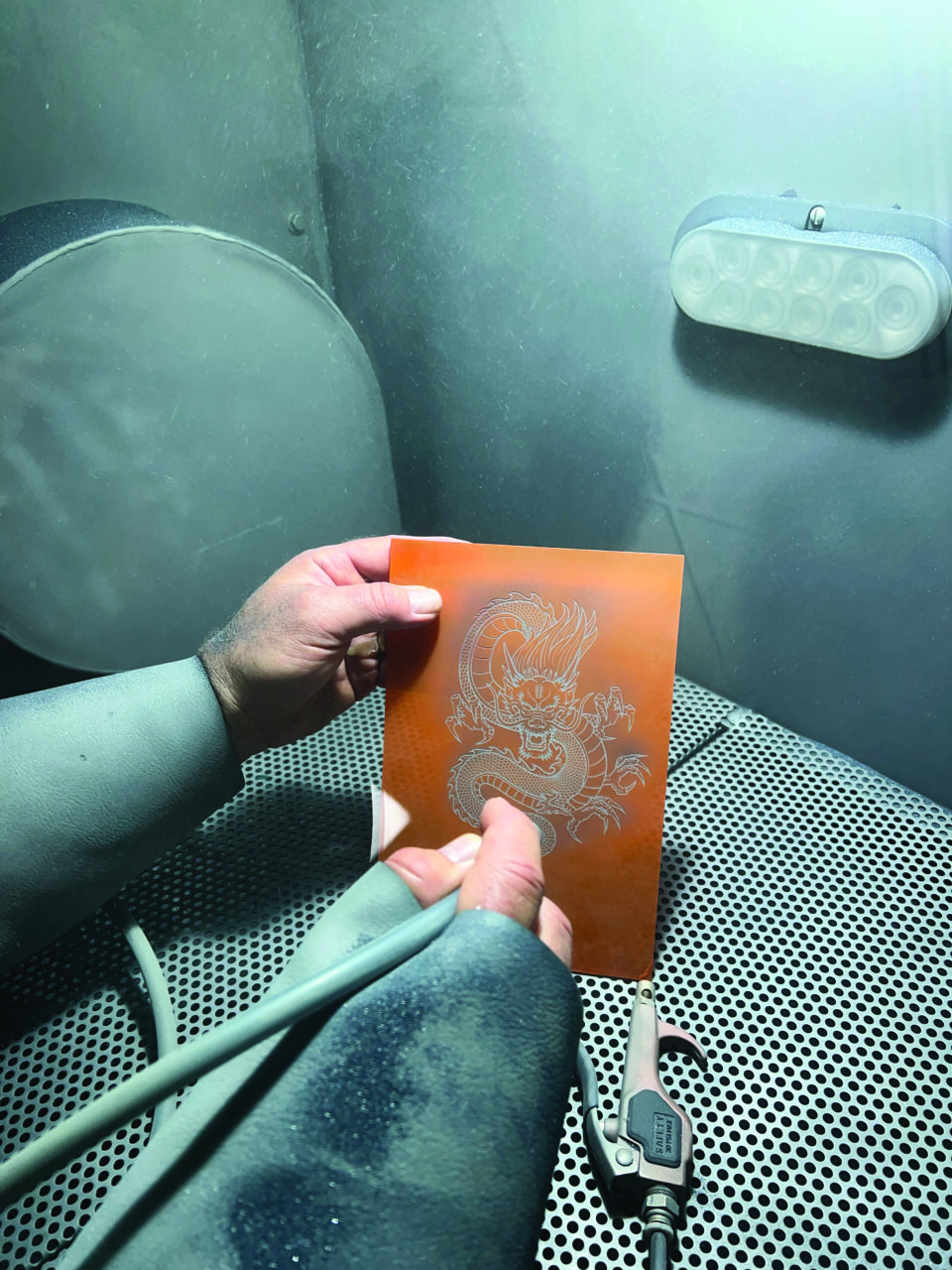
Mixed-media personalization can be an excellent way to expand a retailer’s offerings, provided they start with the right equipment and expertise. Blazering, which combines the benefits of laser engraving and sandblasting, offers retailers a hybrid option that delivers precision and depth for highly detailed products.
Darin Jones, technical training sales specialist at IKONICS Imaging and a blazering advocate, recently shared insights on how retailers can approach this market and what they need to know before jumping in.
Blazering Defined: Clean and Detailed
By combining elements of sandblasting and laser engraving, blazering can create clean, detailed, and deeply etched designs on various substrates. Typical laser engraving produces a shallow burn; sandcarving requires manual stenciling. Blazering, meanwhile, uses a laser to burn the image into the mask on the item before sandblasting for enhanced results.
Ideal Blazering Substrates and Applications
Jones says it’s important to determine if the substrate is ideal for blazering before starting.
“My rule of thumb is if the item is breakable or chippable (like glass, crystal, or porcelain), can’t be lasered, and/or is very fragile, then I will suggest sandcarving for the deep etch,” he stresses.
If the item is scratchable and not breakable, like acrylic and precious metals, Jones recommends laser engraving as an alternative, as the look would be the same.
Jones adds that the selection method will vary based on the customer’s order.
“Lasering will burn, and sandcarving is low-frictional heat,” Jones adds, pointing to wood as an example substrate. “On light wood, laser creates a dark burn, and on the same wood, sand carving creates a deep but lighter image that may require a wood stain.”
Step-by-Step Workflow
Jones says the process starts with artwork: Create a black-and-white design where black areas will be etched. After that, apply a specialized mask, like Blazer Orange, to the substrate. Apply the blastable laser mask evenly and stretch it over curves to avoid bubbles.
The remaining steps are as follows:
Place the item in a laser engraver at tested settings (e.g., high power/slower speed for CO2 lasers). Jones suggests burning through at least 80% of the mask in the laser engraver, and the sandcarving machine will remove the remaining 20%.
“This saves time,” Jones adds. “Testing squares is the most common test; 100% power, 80% power, and so on.”
After finishing engraving, sandblast the product at approximately 40 psi with a nozzle distance of 4 to 6 inches. “We recommend silicon carbide and the sizes between 150 and 220 mesh,” Jones says.
Remove the mask and, if necessary, test additional iterations by laser engraving first, then blasting to create several samples and dial in the best settings for a repeatable process.
Key Points to Remember
The core process of blazering is straightforward, but Jones urges retailers to pay close attention to settings, speed, and mask application for the cleanest results.
“You can see the best of both worlds,” Jones adds. “First, you laser engrave the item, and if you are not satisfied with the appearance or depth, then you can put the item in the sandcarver to get another result.”
Additionally, Jones recommends a consistent etching speed of approximately 1 square inch per second for sandblasting, using pressure pots to ensure steady flow.
Leveling Up
Once retailers are comfortable with basic blazering, they can step up their technique to more eye-catching decoration.
“Practice sandcarving on a blank piece of glass to see the color tones, different angle looks, and close and further away nozzle passes so you can see what your sand carver can do for multilevel and shading,” Jones suggests. “Outlines of the image are good for multilevel carvings. For halftones, use high-resolution artwork so the dots remain sharp and round, which is ideal for sand carving.”
For color fill, Jones recommends images with thick outlines, which create a deep pool for paint to settle into.
Multilevel carving and shading create opportunities for products like drinkware, awards, and gifts, where a 3D-etched look differentiates from traditional flat engraving.
Business Value and Education
Ultimately, blazering can boost retailers’ margins by leveraging uniquely deep etches. Products made of hard glass or stone, for everything from premium drinkware to corporate gifts, often have a higher perceived value, allowing retailers to charge more. Plus, the detailed etching is perfect for online stores since the multi-angle 3D visuals will still look equally striking on a website as they do in person, he adds.
Going beyond a basic getting-started tutorial, Jones recommends that retailers interested in blazering participate in existing educational opportunities. This includes hands-on classes at the APA Expo and workshops hosted by GS2 Awards, a Trotec dealer. Trotec Laser also hosts blazering events at their locations nationwide, which GS2 and IKONICS participate in.
“In today’s market, saturation is real, so offering products that other companies may not be aware of or ignore is an opportunity for a retailer to grow with blazering,” states Jones.